Key Takeaways
- C9 LED bulbs are the gold standard for roofline lighting on New England homes — large enough to read from the street, energy-efficient enough to run all season long.
- Proper clip spacing (12 inches on-center for most rooflines) is the single biggest difference between a DIY look and a professional finish.
- Warm white C9s complement the red brick, cedar shingle, and white clapboard exteriors that dominate Massachusetts neighborhoods.
- A summer survey — conducted months before November demand peaks — locks in your layout, cord routing, and outlet locations before the rush.
- Professional installation includes weatherproof connections, safe ladder work on steep New England pitches, and end-of-season removal and storage.
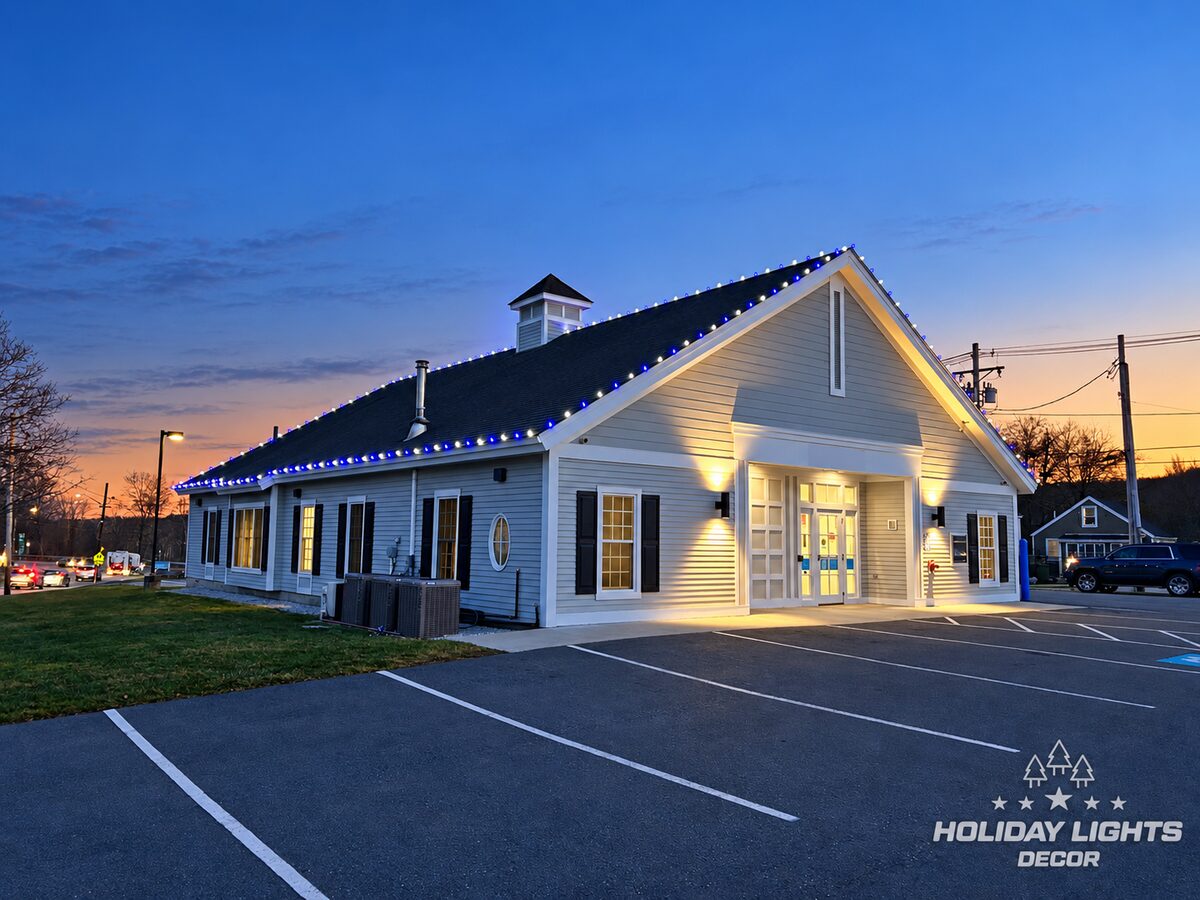
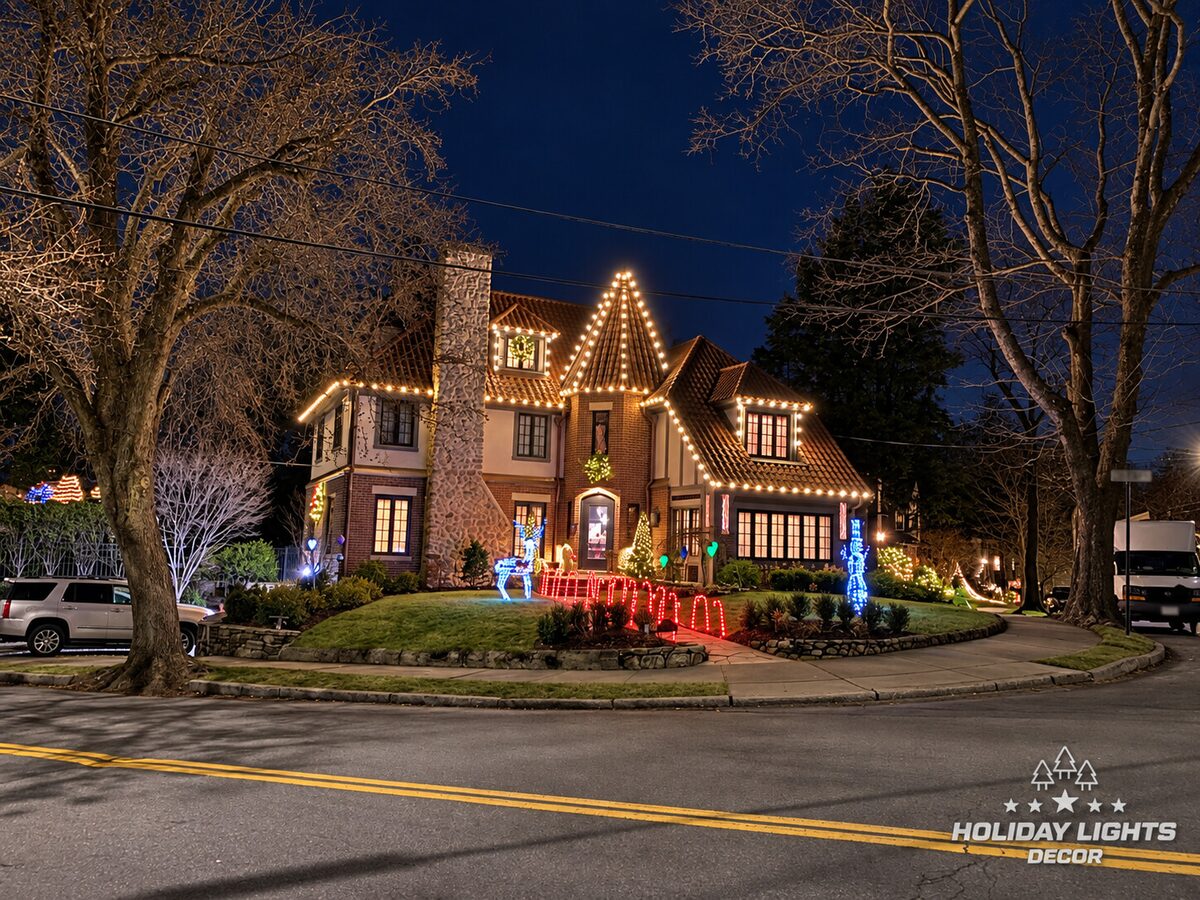
Drive through any well-decorated Massachusetts neighborhood in December and you'll notice immediately which homes hired professionals: the roofline glows in a perfectly spaced, unbroken line of warm white light that traces every gable, dormer, and eave with quiet precision. Those aren't string lights hastily stapled to fascia boards — they're commercial-grade C9 LED bulbs, individually socketed on heavy SPT-2 wire, clipped at exactly 12 inches on-center by a crew that has done this hundreds of times. The difference between that house and its neighbor isn't magic. It's the right product, the right technique, and the right planning window. Here's everything you need to know about professional C9 roofline lighting in Massachusetts.
Why C9 LEDs Define the Classic New England Roofline Look
C9 LED bulbs — the large, strawberry-shaped lamps measuring roughly 1.25 inches in diameter — are the definitive choice for roofline lighting on New England homes because their size, output, and silhouette match the architectural scale of the region's housing stock. A Colonial, Cape Cod, or Victorian farmhouse has deep overhangs, steep roof pitches, and often two or three distinct rooflines stacked on top of each other. Mini lights disappear at that scale; C7s are borderline. C9s read from 50 feet away, which is exactly where your neighbors and passing cars will be viewing your home.
LED Efficiency That Runs All Season
Modern C9 LED replacement bulbs consume roughly 0.5 watts per socket compared to 5–7 watts for their incandescent predecessors — a reduction of up to 90 percent. A typical Massachusetts Colonial with 180 linear feet of roofline requires approximately 180 C9 sockets. Running that display 6 hours per night from Thanksgiving through New Year's Day costs roughly $8–$12 in electricity with LEDs, versus $80–$100 with incandescents. Beyond cost, LEDs produce far less heat, which means lower fire risk on wood fascia and shake roofs — a meaningful consideration in older New England homes. Read more about LED vs. incandescent Christmas lights to understand the full performance comparison.
Warm White: The Perfect Match for Massachusetts Exteriors
Warm white C9s (color temperature approximately 2700K–3000K) are by far the most popular choice on Massachusetts homes, and for good reason. The golden tone complements red brick Federal-style homes in historic districts, the weathered cedar shingles of Cape-style cottages on the South Shore, and the crisp white clapboard siding that defines classic New England farmhouses across the Pioneer Valley and Berkshires. Cool white can look harsh against warm-toned exteriors and clashes with the amber glow of period lantern sconces. Warm white reads as timeless, elegant, and unmistakably New England. If you're curious about trending color palettes, our guide on what colors are popular for Christmas 2026 explores where warm white stands relative to newer options.
Understanding C9 Bulbs: Commercial Grade vs. Retail
Not all C9 bulbs are created equal, and the gap between commercial-grade and big-box retail product is significant. Professional installers use commercial-grade C9 LEDs rated for outdoor use in temperatures down to -40°F — critical for Massachusetts winters where January temperatures in Worcester and Springfield regularly dip below 10°F. Retail C9 strings often use lightweight SPT-1 wire with thinner insulation; commercial wire is SPT-2, which handles the physical stress of wind, ice loading, and repeated removal without cracking.
| Feature | Retail C9 Strings | Commercial-Grade C9 (Professional) |
|---|---|---|
| Wire gauge | SPT-1 (18 AWG) | SPT-2 (18 AWG with thicker insulation) |
| Bulb wattage (LED) | 0.5–1W | 0.5W (same efficiency, better housing) |
| Temperature rating | ~14°F minimum | -40°F rated |
| Bulb replaceability | Sometimes proprietary | Standard E17 base, fully replaceable |
| Expected lifespan | 1–3 seasons | 5–7+ seasons with proper storage |
| Cord color options | Green or white | Green, white, black, brown |
Matching cord color to fascia color is a detail that separates professional installs from amateur ones. A white cord on white trim becomes nearly invisible during the day; a green cord on a brown cedar fascia stands out like a garden hose. Our post on what commercial-grade Christmas lights mean breaks down the specifications in more detail, and the difference between commercial and residential Christmas lights explains why pros never use the same product you'd buy at a hardware store.
Clip Spacing and Clean Installation Techniques
Consistent 12-inch clip spacing is the single most visible marker of a professional C9 roofline installation. At that interval, warm white bulbs create a continuous visual rhythm that your eye reads as a solid line of light rather than a dotted string. Most Massachusetts homes with standard gable rooflines look best at exactly 12 inches; tighter spacing (9 inches) is sometimes used on very long, low ranch rooflines to add visual density.
Clip Types and Fascia-Safe Mounting
Professional crews use all-in-one C9 shingle/gutter clips that hook over the shingle tab without penetrating the roofing material — a key concern on the cedar shakes and asphalt architectural shingles common across Massachusetts. These clips hold the wire flat against the fascia so there's no sagging between sockets. On homes with no gutter (or gutters being used as a mounting surface), crews use all-in-one gutter clips that attach to the forward lip without crushing the gutter channel. No nails, no staples, no holes in your roofing.
Weatherproof Connections and GFCI Requirements
Every connection point — where extension cords meet the main wire, where strings connect at corners and valleys — gets wrapped in self-fusing silicone tape or uses weatherproof vampire connectors. Massachusetts building code requires GFCI-protected exterior outlets, and professional installers work exclusively from those circuits. Cords are routed down downspouts or along corner boards and concealed wherever possible, never dangling across siding. The result during daylight hours: you barely notice the installation. At night, only the light.
Steep Pitch Safety on New England Roofs
Many Massachusetts homes — particularly older Colonials, Saltboxes, and Victorians — have roof pitches of 8/12 or steeper. Professional crews bring extension ladders rated for the specific eave height, use stand-off ladder stabilizers to protect gutters, and deploy roof hooks and harness systems on pitches above 6/12. This isn't something a homeowner should attempt with a hardware-store stepladder. Beyond the obvious safety risk, improper ladder placement crushes gutters and can crack older fascia boards. See our overview of why installing Christmas lights is so expensive for a frank breakdown of the labor and safety investment involved.
Planning a Summer Survey for a Perfect Fall Installation
The best time to plan your Massachusetts C9 roofline display is July or August — months before anyone is thinking about the holidays. A summer survey allows the installation crew to walk the property, measure every roofline section, identify outlet locations, and map cord routing while the weather is cooperative and the schedule is uncrowded.
What a Pre-Season Survey Covers
- Linear footage measurement: Every gable run, eave, dormer, and porch roofline is measured precisely so material orders are exact — no mid-install hardware store runs.
- Outlet audit: Crews identify which circuits are GFCI-protected, how many outlets are available on the exterior, and whether any additional outdoor outlets or timer/smart plug hardware are needed.
- Cord routing plan: The cleanest installs hide power cords entirely. Summer surveys let crews identify downspout channels, soffit gaps, and corner board pathways before leaves and cold weather complicate the job.
- Fascia and gutter condition check: Damaged gutters or rotting fascia boards are much easier (and cheaper) to repair in September than in November. Finding them in summer means your customer can address repairs before installation day.
- Color and style confirmation: Some homeowners want to mix warm white C9s on the roofline with warm white mini lights on trees and shrubs for a layered effect. Summer is the right time to plan that coordination.
Booking early also guarantees your preferred installation date. By mid-October, professional holiday lighting companies in Massachusetts are scheduling weeks out. Our guide on when to book Christmas light installation in Massachusetts explains exactly why the late-summer window is the sweet spot.
What to Expect from a Professional C9 Roofline Installation
A full-service professional installation covers everything from the first clip to the last takedown. Here's how the process typically unfolds for a Massachusetts residential client:
- Pre-season consultation and survey (ideally summer): layout planning, measurements, product selection.
- Custom material order: Commercial-grade SPT-2 wire cut to exact lengths, warm white C9 LED bulbs, matching cord-color clips, weatherproof connectors.
- Installation day (typically October–November): crew arrives with all materials and equipment, installs in 2–6 hours depending on home size and complexity.
- Test and adjust: Every circuit is tested, sagging wires are re-clipped, any non-illuminating bulbs are replaced on the spot.
- Timer or smart plug setup: Lights are connected to programmable timers or smart outlet plugs so the display runs automatically on your preferred schedule.
- Post-season removal and storage: After the holidays, the crew returns, removes all wiring and clips, coils wire properly to prevent kinking, and stores bulbs and materials for next season.
That last step — professional removal and storage — is where the investment in commercial-grade wire pays back most visibly. Properly stored SPT-2 wire laid up on a reel or coiled in bins lasts 5–7 seasons without cracking. Retail wire jammed in a box lasts 1–2. Learn more about end-of-season care through our removal and storage service, or explore the full range of what we offer on our residential lighting services page.
C9 Roofline Lighting Cost Considerations in Massachusetts
Professional C9 roofline lighting in Massachusetts typically runs $400–$900 for a standard Colonial or Cape with 120–200 linear feet of roofline, including materials, installation, and first-season removal. Larger homes with multiple dormers, steep pitches, or extended front and side exposures can run $1,000–$2,000+. That figure includes commercial-grade wire and bulbs that will be reused for multiple seasons, so the per-season cost drops significantly after year one.
For a detailed cost breakdown by home size and feature set, see our article on the cost of Christmas lights on a 2,000 sq ft house in Massachusetts and our companion piece on how much it costs to have a house professionally decorated for Christmas. If you're comparing hourly labor rates, how much to pay a Christmas decorator per hour provides useful context.
Frequently Asked Questions
What makes C9 bulbs the right choice for Massachusetts rooflines specifically?
C9 bulbs are the right choice for Massachusetts rooflines because their large 1.25-inch strawberry-shaped silhouette is proportional to the scale of New England's Colonial, Cape Cod, and Victorian architecture. Smaller mini lights disappear against the deep overhangs and steep pitches common in the region. C9 LEDs also withstand Massachusetts winters — rated to -40°F — making them far more durable than retail string lights during January ice storms and freeze-thaw cycles. The warm white color temperature (2700K–3000K) complements the brick, shingle, and clapboard exteriors that define Massachusetts neighborhoods.
How far apart should C9 clips be spaced on a roofline?
Professional installers space C9 clips 12 inches on-center for most Massachusetts rooflines, which creates a continuous, unbroken visual line of light. On very long, low ranch or ranch-Colonial rooflines, 9-inch spacing adds more visual density. Spacing wider than 12 inches — common in DIY installs — creates a dotted, uneven appearance that undermines the classic New England look. Consistent spacing is the single most visible difference between a DIY and a professional installation.
Why is summer the best time to plan a Massachusetts Christmas light installation?
Summer — specifically July and August — is the best planning window for Massachusetts Christmas light installations because professional companies' schedules are open, your home's roofline and fascia are fully accessible, and outlet locations and cord routing can be mapped without cold-weather pressure. Pre-season surveys completed in summer allow precise material orders, identification of any needed gutter or fascia repairs, and guaranteed booking for your preferred October or November installation date. By mid-October, most reputable Massachusetts holiday lighting companies are booked 3–5 weeks out.
Do professional installers put holes in my roof or gutters?
No — professional installers use non-penetrating shingle/gutter clips that hook over the forward edge of shingle tabs or gutter lips without drilling, nailing, or stapling into your roofing or fascia. This is especially important on Massachusetts homes with cedar shake or premium architectural shingles, where penetration voids roofing warranties. All-in-one clips hold SPT-2 wire flat and secure without damaging gutters. After removal in January, there are no marks, holes, or residue left on your home.
What happens to my C9 lights after the season ends?
With a full-service professional installation, the crew returns after the holidays to remove all wiring, clips, and bulbs. Commercial-grade SPT-2 wire is coiled onto reels or packed in labeled bins, and C9 LED bulbs are stored individually to prevent breakage. This professional storage method extends wire and bulb life to 5–7 seasons, spreading the material cost across multiple years. Homeowners who store their own lights improperly — stuffed in boxes or tangled in bags — typically replace retail wire every 1–2 seasons. Our removal and storage service handles all of this as part of a complete seasonal package.
Can C9 roofline lighting be combined with other professional holiday displays?
Absolutely — C9 roofline lighting pairs beautifully with warm white mini lights on trees and shrubs, lighted garlands and wreaths on doors and columns, and illuminated bows on shutters or railings. Professional designers layer these elements so the roofline anchors the display at the highest visual level while ground-level details add warmth and texture closer to eye height. For homes wanting a year-round architectural lighting solution, permanent lighting systems can replicate the C9 roofline effect with fixed channel hardware and app-controlled color changes for every season. Explore our full range of holiday lighting services to see how a complete display comes together.