Key Takeaways
- The branch-by-branch wrapping technique produces a fuller, more professional look than spiraling lights up the trunk alone — and it matters differently for deciduous oaks and maples versus evergreen arborvitae or blue spruce.
- A reliable mini-light strand formula for Massachusetts trees: multiply trunk circumference (in feet) by tree height, then divide by the strand spacing you want — most pros use one 100-count strand per linear foot of wrapped branch.
- Commercial-grade LED mini lights in warm white or cool white outlast big-box store strings by 3–5 seasons, even through Massachusetts freeze-thaw cycles and nor'easters.
- Common local mistakes include wrapping too early before deciduous trees drop their leaves, ignoring GFCI outlet requirements for outdoor circuits, and using indoor-rated extension cords in New England's wet autumn conditions.
- If the scope of your tree display grows beyond a single tree or two, a professional installation crew can handle every detail — saving you time and preventing costly electrical errors.
Picture a crisp December evening on a Massachusetts residential street: bare silver maples glow amber under thousands of warm white mini lights, their skeletal branches turned into something that looks like bottled firelight. A neighbor's blue spruce blazes in cool white from tip to trunk. This effect doesn't happen by accident — and it definitely doesn't happen by wrapping a single strand around the base and calling it done. Wrapping trees in lights in Massachusetts requires a deliberate technique, the right product choices for our notoriously punishing winters, and a solid understanding of how much material you actually need. This guide covers all of it, from the first knot around a branch tip to the final GFCI plug-in.
Why Massachusetts Conditions Change Everything About Tree Wrapping
Massachusetts outdoor lighting faces challenges that milder climates simply don't — and those challenges directly shape every decision you make about how to wrap trees in lights in Massachusetts. From October through March, your lights will endure sub-zero wind chills off the Atlantic, multiple freeze-thaw cycles per week, heavy wet snow loads, and ice storms that can snap branches and shear strands off entirely.
Standard residential-grade mini lights — the kind sold at most hardware chains — carry an IP44 weather rating at best. That's adequate for a dry Pacific Northwest winter. It is not adequate for a February nor'easter in Worcester or a January ice event on the South Shore. For any exterior tree display you want to last the full season, look for UL-listed commercial-grade LED mini lights with an IP65 rating or higher. These feature sealed bulb sockets, reinforced wire insulation rated to at least -40°F, and locking plug connections that don't loosen when the temperature swings 50 degrees in 48 hours.
Warm white mini lights (typically 2700K–3000K color temperature) are the most popular choice for deciduous trees in Massachusetts, as that amber glow complements the grey bark of maples, oaks, and birches beautifully. Cool white mini lights (5000K–6000K) read more crisp and icy — they work exceptionally well on evergreens like white pine or blue spruce, amplifying the natural blue-green of the needles. You can also layer both on the same property for depth: warm white on the deciduous shade trees, cool white on the evergreens flanking the front walk.
For more on professional product standards, see our post on what type of Christmas lights professionals use.
Deciduous vs. Evergreen Trees: Two Different Wrapping Strategies
The wrapping technique that produces stunning results on a bare maple will look sparse and muddy on a densely needled arborvitae — the two tree types require fundamentally different approaches.
Wrapping New England Deciduous Trees
Deciduous trees (maples, oaks, elms, birches, crabapples) should be wrapped after they have dropped their leaves — this is the single most important timing rule Massachusetts homeowners miss. Wrapping a tree that still holds 60% of its leaves traps moisture, adds wind resistance that strains anchoring points, and hides the branching structure you're trying to illuminate. In most of eastern Massachusetts, full leaf drop happens between late October and mid-November; western Massachusetts (Berkshires and Pioneer Valley) often completes leaf drop a week or two earlier.
- Start at the trunk base. Anchor your first strand at the base with a plastic zip tie or purpose-made light clip — never staple guns, which pierce wire insulation. Spiral upward at roughly a 45-degree angle to the first major branch union.
- Branch-by-branch, not spiral-to-tip. At each major branch union, break off and dedicate a separate run to that branch. Work your way from the largest scaffold branches down to the secondary and tertiary branches. This creates a three-dimensional glow rather than a flat outline.
- Maintain consistent spacing. On scaffold branches (3–6 inches diameter), wrap every 2–3 inches. On smaller terminal branches (under 1 inch), you can stretch to 4–5 inch spacing, as the branch itself is more visible.
- Leave the very tips unwrapped. The last 12–18 inches of branch tips on deciduous trees are too flexible in wind and too fragile for consistent wrapping — lights will slip and bunch. Let the tips stay dark; they frame the glow perfectly.
Wrapping Evergreen Trees
Evergreens like arborvitae, white pine, blue spruce, and eastern hemlock retain their foliage year-round, which means the approach shifts from skeletal illumination to layered surface coverage.
- Work from the inside out. Begin at the trunk and spiral outward toward the branch tips, tucking strands into the interior of the canopy first. Interior lighting gives depth and prevents the flat, surface-only look that screams amateur.
- Follow the natural tiers. Most evergreens grow in distinct horizontal tiers. Treat each tier as its own wrapping zone with a dedicated strand run.
- Use higher density on evergreens. Because needled foliage diffuses light more than bare bark, evergreens need roughly 25–30% more strand footage than a comparably sized deciduous tree to achieve the same visual brightness.
- Never pull strands tight. Evergreen branches are resinous and flexible; overtightened strands cut into soft bark and create girdling damage over time. Keep wraps snug but not constricting.
For properties with specimen trees that deserve a truly professional treatment, our tree lighting services include a site assessment, strand calculation, and full installation by our Massachusetts crew.
Calculating Mini-Light Strand Footage: The Massachusetts Formula
The most common reason DIY tree wrapping looks underwhelming is simple underestimation of material — most homeowners buy half the strands they actually need. Here is the practical formula we use on residential and commercial installations across Massachusetts.
Step 1: Measure Trunk Circumference and Tree Height
Wrap a flexible tape measure around the widest point of the trunk (usually 4 feet above grade, the standard DBH measurement). Note the circumference in inches and convert to feet. Also measure total tree height in feet from grade to crown tip.
Step 2: Apply the Branch Coverage Multiplier
Use this reference table for common Massachusetts trees:
| Tree Type | Typical Crown Spread | Coverage Multiplier | Mini-Light Strands (100-count) per 10 ft height |
|---|---|---|---|
| Sugar Maple (deciduous, mature) | 30–40 ft | 1.8× | 8–10 strands |
| Red Oak (deciduous, mature) | 40–50 ft | 2.0× | 10–14 strands |
| Paper Birch (deciduous, slender) | 15–20 ft | 1.4× | 4–6 strands |
| Arborvitae (columnar evergreen) | 4–6 ft | 1.6× | 5–7 strands |
| Blue Spruce (evergreen, pyramidal) | 10–15 ft | 2.2× | 9–12 strands |
| White Pine (evergreen, open) | 20–30 ft | 1.9× | 8–11 strands |
Step 3: Account for Daisy-Chaining Limits
LED mini light strands can typically be daisy-chained in runs of 40–50 strands (always verify the manufacturer's maximum — exceeding it causes overheating and trips breakers). For large trees requiring more than 40 strands, plan two or more separate circuits drawing from different GFCI outlets. Most Massachusetts homes with older electrical panels should have a licensed electrician evaluate outdoor circuit capacity before a large installation — our team includes this as a standard part of our residential holiday lighting service.
Curious about what professional installation actually costs? Our breakdown of the cost of Christmas lights for a 2,000 sq ft Massachusetts home walks through typical ranges in detail.
Common Mistakes Massachusetts Homeowners Make — and How to Avoid Them
Years of installation experience across Massachusetts neighborhoods — from Cape Cod cottages to Colonial Revivals in the Merrimack Valley — have shown us the same errors repeated season after season.
Mistake 1: Wrapping Before Leaf Drop
As noted above, wrapping deciduous trees before full leaf drop adds wind resistance, traps moisture, and hides the branching you spent money illuminating. Patience pays off — wait for at least 90% leaf drop before touching the first strand.
Mistake 2: Using Indoor-Rated Extension Cords Outdoors
Indoor extension cords have thinner insulation and unsealed connections. In Massachusetts, a single rain-soaked ground cord can trip a GFCI, short a circuit, or — in worst cases — start a fire in leaf debris. Use only UL-listed, 12 or 14-gauge outdoor extension cords rated for wet locations. Orange or yellow outdoor cords are the standard; anything with a flat, two-prong, white plastic plug is an indoor cord and does not belong outside.
Mistake 3: Skipping GFCI Protection
Massachusetts electrical code (following the NEC) requires GFCI protection for all outdoor receptacles. If your exterior outlets predate the requirement or were grandfathered in, add a GFCI outlet or use a GFCI-protected extension cord. This is non-negotiable in New England's wet autumn and early-winter conditions.
Mistake 4: Buying the Wrong Color Temperature
Warm white mini lights (2700K) and cool white (5000K) look dramatically different in person versus on a product page. Buy a single test strand and run it on your tree at night before committing to 30 strands of the wrong tone. Warm white pairs naturally with brick, cedar shingles, and Colonial or Victorian architecture common across Massachusetts. Cool white reads more contemporary and suits modern farmhouses, Cape-style homes, and Craftsman bungalows. For color trend context, see our post on what colors are popular for Christmas 2026.
Mistake 5: Storing Strands Improperly After the Season
Massachusetts attics hit 130°F in summer; crawl spaces collect moisture all year. Both extremes degrade LED mini light insulation faster than outdoor use does. Store strands in a climate-controlled space, coiled loosely on a reel or around a cardboard spool — never balled up in a bin where strain points crack the insulation at contact points. Our removal and storage service handles this for you, including condition inspection before the following season.
Timing Your Installation in Massachusetts
The Massachusetts installation window is narrower than most homeowners expect. You need: leaves down (late October–mid-November), temperatures above 20°F for connector flexibility, no imminent precipitation, and daylight hours to work safely. That window typically runs from mid-November through the first week of December — which is why scheduling fills up fast.
If you're considering a professional installation, our post on when to book Christmas light installation in Massachusetts explains exactly when to reach out and what the booking process looks like. Spoiler: early-to-mid October is not too early.
For commercial properties — retail centers, office parks, HOA common areas — the timeline compresses further because permitting, lift equipment scheduling, and multi-tree scope add coordination time. Our commercial holiday lighting services are typically scheduled by September for December installs.
When to Call a Professional Instead
DIY tree wrapping works well for one or two small-to-medium trees with straightforward access and standard 120V outdoor circuits. The math tips toward professional installation when:
- Your trees exceed 25 feet in height (ladder safety becomes a serious issue on uneven Massachusetts terrain)
- You have more than three trees to wrap (the labor time exceeds most homeowners' weekends)
- You want integrated timer systems, smart-home controls, or multi-zone color schemes
- Your property has mature specimen trees where branch damage from improper wrapping is a real financial loss
- You're interested in permanent lighting systems that run year-round and eliminate annual reinstallation
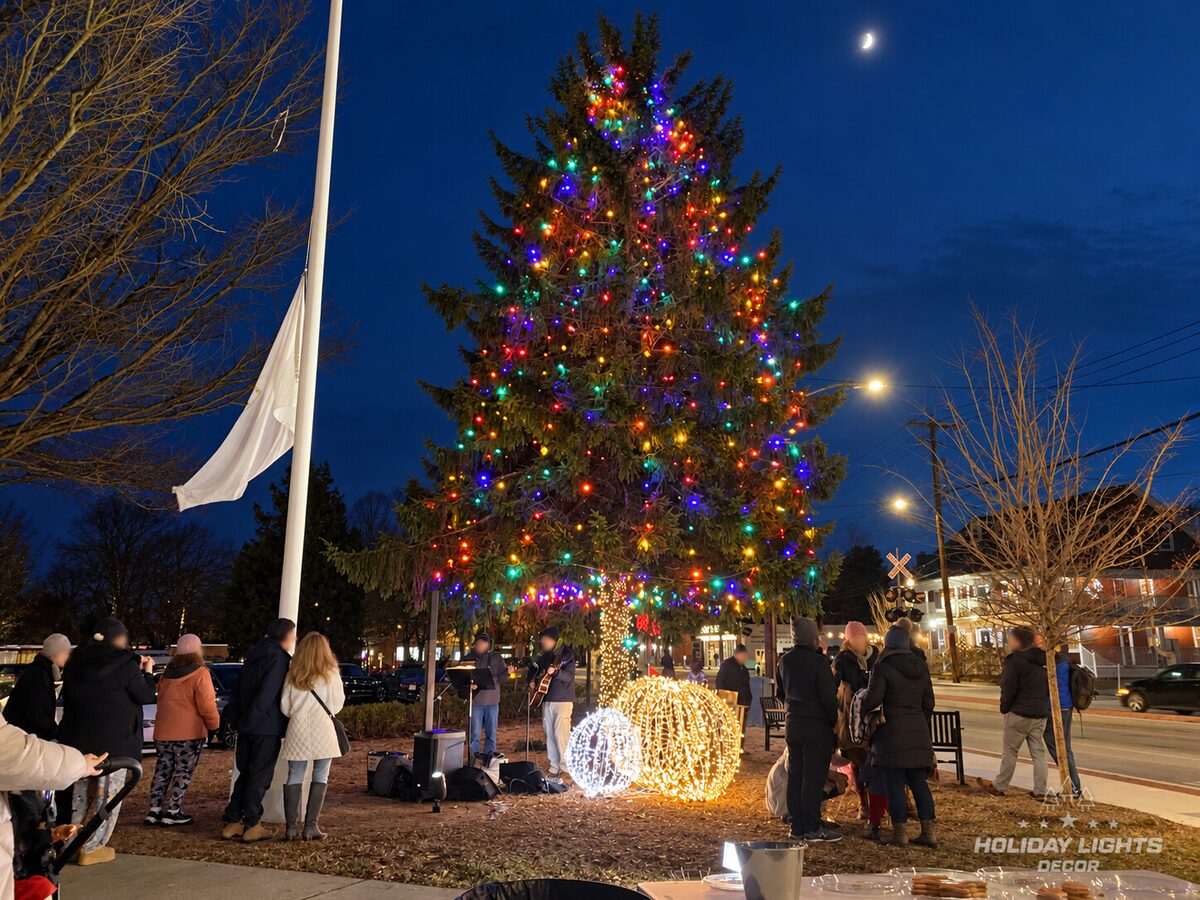
Our team serves residential, commercial, and municipal clients across Massachusetts — from single-family properties in the suburbs to town common tree displays in historic New England downtowns. If you're unsure where your project falls, a quick consultation call clarifies everything. See our full range of holiday lighting services or read our guide on whether you can pay someone to decorate your house for Christmas for a full picture of what professional service includes.
Frequently Asked Questions
How do I calculate how many mini lights I need to wrap a tree in Massachusetts?
The practical rule is 100 mini lights per linear foot of wrapped branch, or roughly 8–14 strands of 100-count lights per every 10 feet of tree height, depending on crown density. Measure trunk circumference at chest height and total tree height, then use the coverage multiplier for your tree type (see the table above). Always buy 15–20% more than your calculation suggests — it's far easier to return unopened boxes than to make a second trip when you're halfway through installation in November cold.
When is the best time to wrap trees in lights in Massachusetts?
For deciduous trees, wait until at least 90% of leaves have dropped — typically mid-to-late November in eastern Massachusetts and slightly earlier in the Berkshires and Pioneer Valley. Aim for installation days with temperatures above 20°F and no rain or snow in the forecast, as cold-stiffened wire and wet connections both create problems. For evergreens, timing is more flexible, but mid-November remains the sweet spot to catch the full holiday season without rushing.
What's the difference between warm white and cool white mini lights for outdoor trees?
Warm white mini lights (2700K–3000K) emit an amber-gold glow that complements the grey bark of deciduous trees and suits traditional New England architectural styles like Colonials, Capes, and Victorians. Cool white mini lights (5000K–6000K) produce a crisp, icy tone that pairs naturally with evergreens and modern home styles. For a cohesive property display, many Massachusetts homeowners use warm white on deciduous shade trees and cool white on evergreen shrubs or specimen conifers, creating visual separation across the landscape.
Can I leave mini lights wrapped on trees through the entire Massachusetts winter?
Commercial-grade LED mini lights with an IP65 rating or higher are engineered to handle Massachusetts winters, including temperatures well below 0°F, ice loading, and UV exposure. Standard residential-grade strings are not rated for continuous outdoor exposure through a full New England winter and will fail prematurely. If you plan to leave lights installed from November through February or beyond, invest in commercial-grade product from the start — the per-strand cost is higher but the multi-season lifespan makes it less expensive over time.
How many trees can I wrap from a single outdoor electrical outlet in Massachusetts?
A standard 15-amp GFCI outdoor circuit can safely handle approximately 1,440 watts of continuous load (80% of the 1,800-watt circuit capacity, per NEC guidelines). A 100-count strand of commercial LED mini lights draws approximately 4–7 watts, meaning a single 15-amp circuit can power 200–300 strands safely — enough for several medium-sized trees. However, voltage drop over long extension cord runs reduces effective capacity, so large installations spanning a wide front yard often benefit from multiple circuits. A licensed Massachusetts electrician can evaluate your panel and exterior circuit layout before a major installation.
Is it worth hiring a professional to wrap trees in lights, or should I do it myself?
For one or two trees under 20 feet tall with easy ground-level access, DIY installation is very manageable with the right materials and this guide. For taller trees, large quantities of trees, complex multi-zone electrical setups, or properties where a fallen ladder would mean a hospital visit, professional installation pays for itself in safety and time savings alone. Professional crews also bring commercial-grade product, warranty-backed workmanship, and post-season removal service. See our breakdown of how much it costs to have a house professionally decorated for Christmas to compare DIY material costs against full-service pricing.
Ready to transform your Massachusetts property this season? Whether you want to tackle your trees yourself or hand the project to our experienced crew, we're here to help. Contact us today for a free estimate — no obligation, just honest advice and accurate pricing for your specific trees and property.